
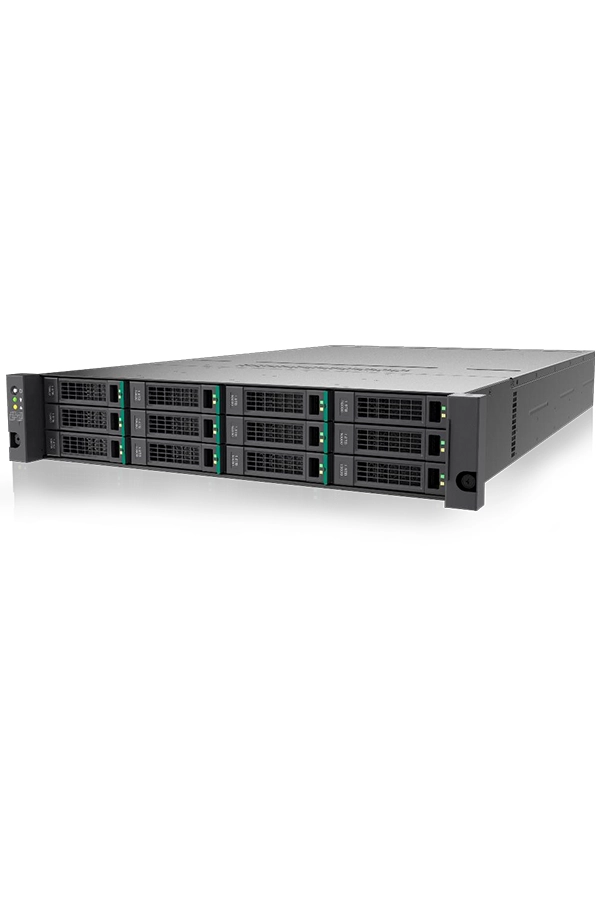
MPS2500G3 Storage

Maipu MPS2500G3-12E is Maipu’s new generation entry-level hybrid flash storage system, built on an X86 CPU hardware platform, designed to meet the needs of small and medium-sized data centers. With its leading hardware architecture and rich software features, it delivers powerful performance support for various data center scenarios such as databases, virtualization, centralized online storage, backup storage, disaster recovery, providing a secure, reliable, intelligent, and efficient storage solution.

Based on the unified MPSP software platform, the MPS2500G3-12E offers mid-to-high-end storage quality at an entry-level price, delivering higher reliability, performance, and scalability than comparable products in the same price range, enabling better support for rapid business growth.

Product Features

R

Flexible Cache Configuration

Dual-controller support for 128GB to 512GB cache configurations, allowing users to flexibly select based on actual application requirements.
R

Flexible Choice of Hard Disk Types

Support SSD, SAS, NL-SAS, and SATA hard disks.

R

Flexible Networking

Support 1/10/25/100Gb/s Ethernet module, 16/32Gb/s FC, and other interfaces, which can help users easily build IP SAN, FC SAN and IP/FC hybrid networking environment.

Powerful scalability

R

Highly Efficient Horizontal Scaling

The MPS2500G3-12E in-rack controllers are interconnected via high-speed 25GE RDMA links, utilizing a horizontal SAN expansion architecture. It supports online horizontal expansion through 10/25/100GE Ethernet and 16/32G FC network protocols, scalable up to 16 storage controllers, 4TB of first-level cache, and a maximum drive capacity of 12,800 drives, enabling the construction of large-scale parallel storage systems to meet growing data processing demands.
R

1600 Hard Disk Expansion

Dual control supports 1200 hard disks, which fully meets the expansion requirements of users’ service development for the storage capacity.
R

34 Host Interface Expansion

The dual-control system has fixed 1Gb/s Ethernet interfaces and 10Gb/s Ethernet interfaces, which can be expanded to 1/10/25/100Gb/s Ethernet, 16/32Gb/s FC by external I/O modules at the same time.

High Reliability

R

Full Redundancy and Modular Design

MPS2500G3-12E adopt full redundancy architecture to ensure system reliability. The main components of the controller, such as chassis, controller, power supply, fan, and host interface card, adopt modular design, and support hot-swap and online replacement of individual components. When some components fail, it can realize rapid fault isolation and component replacement to avoid great impact on the whole system.
R

Dual-Controller Active-Active Architecture Design

The controller adopts an Active-Active redundant dual-controller architecture, sharing data caching, I/O paths, and disk resources to achieve load balancing for storage workloads and improve storage system access performance.
R

CRAID Technology

The unique IDDC+CRAID technology can realize minute-class rapid reconfiguration of partially damaged hard disks. A single RAID group can tolerate the failure of any three hard disks without data loss. Based on the global load technology, IO is distributed to all hard disks, greatly improving IO concurrency and realizing rapid reconfiguration. The reconfiguration time of 1TB data can be shortened to within 30 minutes, and it allows multiple disks of a RAID group to have media failures without data loss. At the same time, combined with the slow power-on technology of the hard disk of the storage system, avoid the risk of current overload and tripping caused by the simultaneous power on of a large number of hard disks, so as to further ensure the high reliability of the system. In addition, the product supports the mixed insertion, hot –swap, and online replacement of different types of hard disks in the same hard disk cabinet to further ensure data security.
R

Data Consistency Protection

It supports data consistency protection based on T10 PI. In the process of data reading and writing, it ensures the data integrity of the whole path from the host port to the hard disk, prevents silent data errors, and ensures the safety of user data.
R

Cache Freezing Technology

When the data cannot be written due to flash failure or failure of the data disk, the data in the cache can be frozen. After the data disk is repaired, the frozen cache data will be distributed to the data disk to ensure that the data is not lost.
R

Controller Self-Healing Technology

It supports cache mirroring. When two nodes of dual control storage are abnormal at the same time (crash or software and hardware failure, etc.), the storage operating system can quickly and automatically repair to the normal operation state and ensure that the cache data is not lost and the upper-layer service is not interrupted.

Rich functions

The MPS2500G3-12E offers a rich set of data protection features, including data snapshots, data replication, cloning, and symmetric active-active capabilities, delivering multi-layered, cross-regional data protection solutions. Additionally, the MPS2500G3-12E provides diverse data management functions, enhancing performance and storage efficiency.
R

Leading Symmetrical Dual-Active Scheme

Without introducing any third-party software and hardware, directly realize the dual-active operation of two storages through two MPS2500G3 series storage arrays, which are redundant to each other. When one storage fails, the other storage can take over the service in real time, realizing zero RPO and RTO. The dual-active link between devices supports 10/25/100GE Ethernet and 16/32G FC. The dual-active feature can be combined with replication to achieve a ring-shaped 3DC disaster recovery solution across multiple sites and geographies, providing high reliability at the solution level.
R

Data Snapshot

It supports continuous data snapshot function and can create up to 2048 incremental historical time point copies for a single data volume. When data «soft» failures occur, such as data damage, virus damage, accidental deletion caused by software programs, data can be quickly recovered by «rolling back» the appropriate time point mark. This function is especially suitable for continuous data protection of critical services.
R

Data Replication

Supports both synchronous and asynchronous replication, allowing online switching according to business needs, balancing business performance and data protection. Supports local replication within devices and remote replication across devices, with replication links supporting 10/25/100GE Ethernet and 16/32G FC, providing users with flexible configuration options. Asynchronous replication supports customizable data transmission intervals and offers various configurations such as hop-by-hop, one-to-many, and many-to-one, enabling rapid business recovery based on data replicas in the event of unexpected disasters, ensuring continuous business operations. Synchronous replication operates at the I/O level, maintaining a fully synchronized real-time mirror of the primary data; when the primary data fails, the mirrored data can take over storage services, achieving PRO=0.
R

Cloning

The cloning feature provides an online, highly available, and flexible data copy that is identical to the production volume at a specific point in time. After cloning, the cloned volume can be immediately provided to front-end applications for use without waiting for data synchronization to complete, making it suitable for application scenarios involving frequent data analysis or testing. It supports both forward and reverse synchronization, enabling rapid synchronization based on differential data without requiring a full re-cloning of all data, thus achieving continuous data protection and flexible usage.
R

Non-Interrupt Data Migration (NDM)

The NDM technology can realize data migration within a single device and across devices, without front-end perception and service interruption during the migration process. Hybrid arrays can realize non-interrupt data migration between the NDM technology and full flash arrays.
R

SAN/NAS integration

In the same set of hardware equipment, both SAN and NAS services are provided at the same time, without configuring additional NAS gateway equipment, reducing equipment investment, shortening data access paths, and effectively reducing the complexity of deployment and operation and maintenance.
R

Auto Layering/Hot Cache

With the ICMT technology, there is no binding relationship between LUNs, RAID, and hard drives. By leveraging cell-based data copy and migration, data can freely move across different disk media based on access frequency, enabling automatic tiering and a two-level hot cache for hot spots.
R

Intelligent Cache Scheduling

Adopt asymmetric cache scheduling technology to dynamically adjust the size of read and write cache according to the actual situation, to meet the real-time changing performance requirements of LUN and realize QoS requirements.
R

Dynamic Load Balancing

Support dynamic load balancing between controllers, adjust workload between controllers without interruption, eliminate performance bottlenecks, and achieve strict service-class goals.
R

Thin Provisioning

ICMT-based thin provisioning technology, the system automatically identifies front-end service IO and dynamically allocates storage resources, which can greatly reduce the difficulty of capacity planning for system administrators.
R

Quality of Service Control QoS

Integrate and pool storage resources such as CPU, memory, bandwidth, and give priority to service requests with higher priority according to the importance of the service, so as to make the system resource allocation more reasonable.

Flash-oriented smart storage platform

The high performance of flash disk has been unanimously recognized in the industry. With the help of MPSP storage operating system, MPS2500G3-12E series storage integrates this leading hard disk technology into its high-performance architecture to provide the ultimate flash converged solution.
R

Intelligent Media Identification Realizes Extreme Performance

MPSP storage operating system can intelligently identify the back-end storage media, automatically execute flash optimization algorithm for flash disk, reduce the operation frequency of hard disk, shorten the IO path, and provide extreme performance.
R

Global Wear Balance Improves the Service Life of Flash

Based on CRAID3.0 and integrating the characteristics of flash memory, the CRAID3.0 flash memory optimization technology can cut each flash disk into several small blocks to form a global resource pool, and then intelligently distribute IO to all small blocks through a certain discrete algorithm, to achieve global wear balance and greatly improve the service life of flash memory.

Cost-Effective

R

High Performance

With flexible configuration choice, it can at least meet the disclosed budget needs at the initial stage of enterprise information construction.
R

Unified Management interface

Adopt the wizard configuration, and the administrator can complete the relevant configuration with a simple click of the mouse. Multiple devices can be managed at the same time on one management interface, which simplifies complexity and is suitable for management under large-scale deployment.
R

Smooth upgrade

Maipu storage management platform (MPSP) can manage a full range of hybrid array products. It can be smoothly upgraded to a higher product series by replacing the hybrid array controller. There is no need for data migration during the upgrade process, which effectively protects user investment.

Download Technical Data Sheet

For product specifications, technical data, and order information, please download the Technical Data Sheet below.