
Maipu HCI Solution

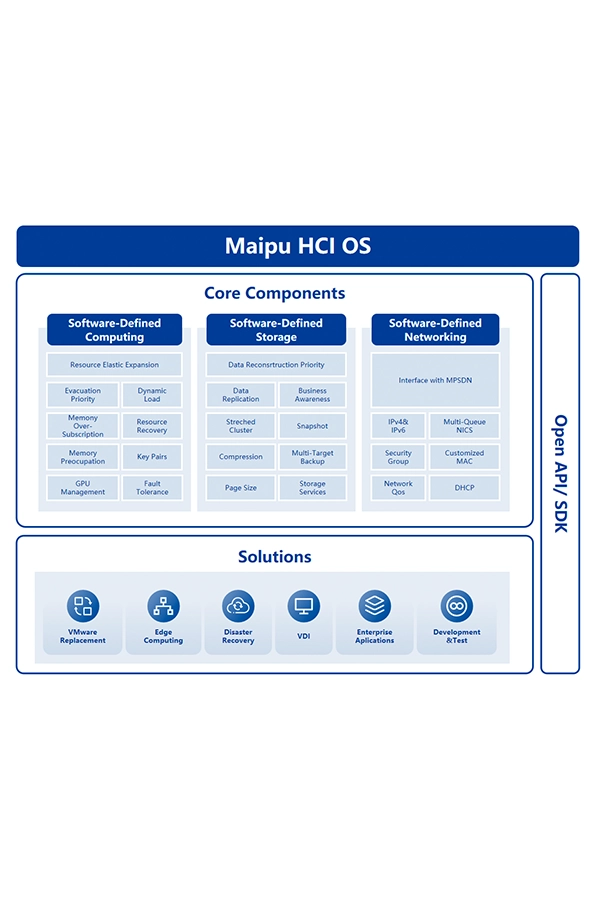
Maipu HCI OS is a software-defined and cloud-prepared offering that features a Hyper Converged Infrastructure (HCI). This architecture seamlessly combines compute, storage, and network resources, possessing traits like elastic resource scaling, application intelligence perception, and the ability to support diverse mixed applications.

Maipu HCI OS is capable of furnishing enterprises with IT infrastructure that exhibits high performance, high availability, and high efficiency, along with effortless installation and maintenance. It can promptly initiate the cloud transformation journey for enterprise clients and present them with comprehensive transformation blueprints.

Maipu HCI OS is capable of serving a wide range of enterprise customers, covering industries like public service, finance, healthcare, education, transportation, energy, and construction. It has the potential to earn the trust of customers by virtue of its advanced technology and high-quality service.

(Note: The product information may not be latest. For the latest, please contact overseas@maipu.com)

Product Features

R

Product Architecture

Maipu HCI OS empowers users to accomplish hyper-converged software and hardware management, presenting a wealth of convenient and user-friendly functions.

It consists of crucial components including software-defined computing, software-defined storage, and software-defined network. The unified management platform offers fundamental operation and maintenance capabilities as well as advanced network functions. Maipu HCI OS adopts a software-defined data center architecture, which abstracts and aggregates hardware resources into virtual resources and dynamically assigns them to services operating within virtual machines or containers.

R

Compute Virtualization

By virtualizing servers, standard VMs are furnished to end users. The entire system, incorporating virtual hardware, operating systems, and configured applications, can be expeditiously and smoothly migrated between different server nodes with the same architecture without disrupting VM services. High availability for service applications is attained via fault evacuation, fault tolerance, and other mechanisms.
R

Storage Virtualization

Maipu HCI OS aggregates the local disks of multiple server nodes into a dynamically expandable global storage resource pool, supplying storage space for VMs. It utilizes flash storage resources (such as NVMe or SATA SSDs) as cache space to augment storage performance and deploys SATA or SAS hard drives to offer storage capacity and optimize storage for services. This setup creates an ideal storage environment for VM applications within the cluster.
R

Network Virtualization

Maipu HCI solution presents a software-only unified network and security solution. The Overlay network can be employed without being tied to hardware to achieve unified coverage of heterogeneous underlying hardware, diverse virtualization architectures, and multiple networks. It supports efficient forwarding and potent network functions. Maipu HCI solution offers more flexible and diversified traffic policy scheduling, integration of a rich third-party network security ecosystem, to deliver a comprehensive security solution.
R

Unified Platform

Maipu HCI OS supplies a centralized management platform to supervise both physical and virtual resources within a cluster. Physical resources comprise server nodes, CPUs/GPUs, memory, disks, and networks. Virtual resources include virtual machines, virtual networks, and virtual storage. The platform provides unified user policies and log records and backs a one-click inspection function to evaluate the overall health status of the platform.
R

Open API/SDK

Maipu HCI OS furnishes Open API and Java SDK documentation manuals for seamless integration with third-party systems and platforms. For security precautions, Maipu HCI OS supports platform access through API keys, facilitating the construction of reliable solutions with ecosystem partners.

Key Features

R

Intelligent Management

Maipu HCI OS backs Automatic discovery and one-click scaling for node expansion. Software upgrades occur automatically without affecting applications. The platform encompasses a variety of «one-click» operation and maintenance tools, such as one-click cluster inspection, one-click resource optimization, and one-click large-screen display, streamlining operation and maintenance tasks and enhancing the efficient and rational allocation of platform resources.
R

High-Performance Cluster

Maipu HCI OS presents more efficient data storage read and write paths along with a hierarchical mechanism for handling cold and hot data. It delivers optimal storage performance by enabling flexible control over the read and write cache ratio. It supports both single and multi-NUMA technologies to boost memory access efficiency for high-performance applications. SPDK technology overcomes Linux storage system bottlenecks, reducing performance losses due to complex system calls and effectively enhancing storage system performance. Maipu HCI OS supports VxLAN for efficient network interconnection and provides NIC multi-queue, SR-IOV, and interrupt-bound core features to increase network speed and decrease latency.
R

VMware Replacement

Maipu HCI OS Cloud furnishes a range of VMware alternative solutions for enterprises, spanning from co-management and interoperability to partial replacement and full replacement (Maipu Cluster Management Platform CMP). Additionally, it supplies cloud migration tools to transfer VMs from VMware to Maipu CMP. Maipu CMP integrates VMware DR solutions, enabling the migration of VMware VMs backup to the Maipu CMP platform, while also possessing the capacity to revert migrated VMs to VMware.
R

Application Awareness

The Maipu HCI OS Cloud application awareness functionality couples distinct optimization strategies according to diverse applications. For example, IT administrators can synchronize the size of application data blocks with disk page sizes to attain peak performance. Diverse compression levels are implemented on different kinds of business data to maximize available storage space. HA priority and rebuild priority ensure the preferential restoration of crucial services, optimizing QoS levels to ensure top-notch performance, availability, and security.
R

Storage Page Size

In general, SDS utilizes a fixed storage page size, which might not always be in harmony with the data block size of application software (as illustrated in Scenarios 1 and 2 in the diagram below), thus affecting storage performance. Maipu HCI OS presents a customizable storage page characteristic that empowers users to configure the page size (4K, 8K, 16K, and 32K) for each virtual disk (as demonstrated in Scenario 3 in the diagram below). This guarantees that the storage page size corresponds to the data block size of application software, thereby enhancing storage performance.
R

High Availability Priority

Maipu HCI OS backs a high availability priority function that gives precedence to applications according to their significance. This ascertains that when a host node encounters problems, VMs operating on that node can promptly recuperate on another sound host node within the cluster, reducing the outage time for high-priority applications to the bare minimum.
R

Service Level

By setting the CPU Quality of Service (QoS) for VMs running diverse critical applications, Maipu HCI OS averts resource competition among them. It offers memory exclusivity and memory reclamation functions to optimize memory allocation. Defining disk QoS for different application VMs eradicates the adverse impacts caused by neighboring interference. Network QoS ensures higher priority scheduling for important applications. Maipu HCI OS supports intelligent storage data synchronization and manual data synchronization QoS.

Typical Application

R

Deployment Recommendations for HCI

  • Node Range Supported by a Single Cluster: 2 – 32
  • Number of Nodes Supported by Multiple Clusters: 100+
  • The node types include 2 – 3 management nodes (which also serve as computing and storage nodes simultaneously), and the rest are hyper-converged nodes for computing/storage.
R

Hardware Recommendation

  • All in One Device (Appliance):
    The Maipu Appliance: MPA201-G3 Series
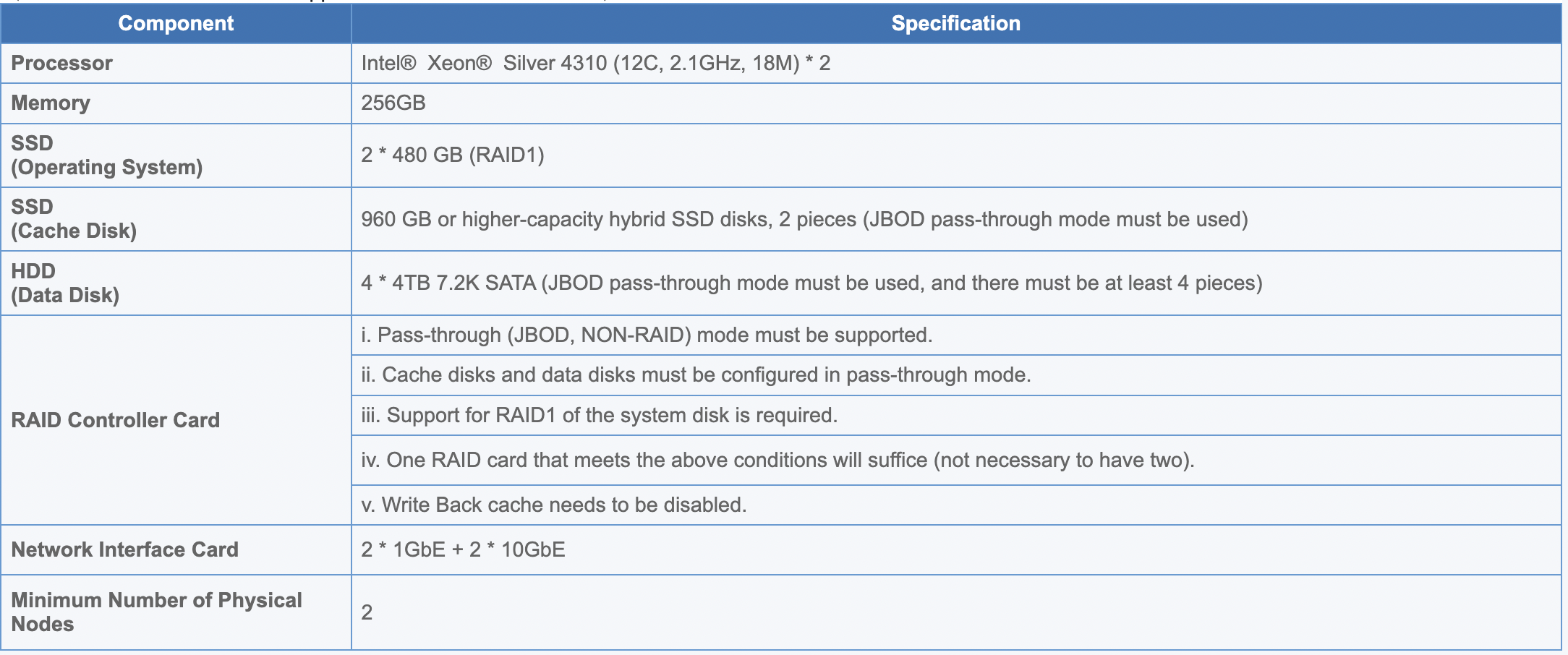
  • Server configuration:
    (Please contact our technical support team for more assistance.)
Download Technical Data Sheet

For product specifications, technical data, and order information, please download the Technical Data Sheet below.